


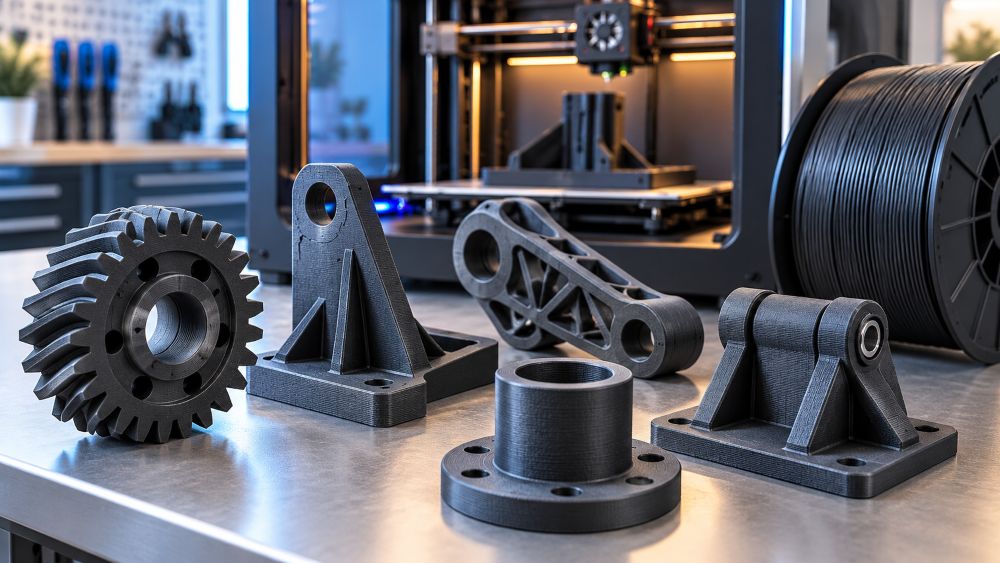
Looking for strong, wear-resistant mechanical components or functional prototypes? Print3DEasy offers custom nylon 3D printing services for individuals, engineers, workshops and businesses.
Nylon, also known as polyamide (PA), is a popular engineering plastic for 3D printing thanks to its excellent mechanical properties, toughness, wear resistance and durability.
We manufacture custom nylon parts from your 3D models, help you select suitable materials and optimize designs for additive manufacturing.
Whether you need a single replacement part, a functional prototype or a small production batch, we can help turn your digital design into a physical product.
What Is Nylon 3D Printing?
Nylon 3D printing is an additive manufacturing process that uses polyamide, a technical thermoplastic known for its strength, toughness and resistance to mechanical wear.
In FDM/FFF 3D printing, nylon filament is heated and deposited layer by layer to create a three-dimensional object.
Unlike plastics mainly used for decorative applications, nylon is particularly suitable for functional components exposed to friction, vibration, impacts and repeated mechanical stress.
Its combination of strength, flexibility and durability makes it a valuable material for engineering and industrial applications.
Advantages of Nylon 3D Printing
High Mechanical Strength
Nylon offers an excellent balance of strength and toughness, making it suitable for mechanical brackets, supports, housings and other functional components.
The final strength of a 3D-printed part depends on the nylon grade, design, printing orientation and manufacturing parameters.
Excellent Wear and Friction Resistance
Polyamide provides good abrasion resistance and relatively low friction, making it useful for gears, bushings, guides and moving mechanical components.
These characteristics make nylon a popular choice for applications involving repeated contact between parts.
Impact Resistance
Nylon can absorb impacts and deformation better than many rigid, brittle plastics.
This property is particularly useful for components exposed to vibration, sudden loads or repeated mechanical stress.
Toughness and Flexibility
Nylon combines rigidity with a degree of flexibility. It can be used to manufacture clips, snap-fit connectors, fasteners and components that require limited elastic deformation.
Heat Resistance
Many nylon grades offer better heat resistance than standard PLA.
However, maximum operating temperatures depend on the specific polyamide formulation, mechanical loads and environmental conditions.
Manufacturing Without Molds
Custom nylon 3D printing allows the production of individual components, prototypes and small batches without expensive injection molds.
This makes additive manufacturing an attractive solution for product development, equipment repairs and low-volume manufacturing.
What Parts Can Be 3D Printed in Nylon?
At Print3DEasy, we can evaluate a wide range of custom nylon 3D printing projects.
Mechanical Gears and Components
Custom gears, pulleys and mechanical transmission components for suitable applications.
Brackets and Mounting Parts
Durable brackets, clamps, connectors, adapters, mounting supports and fastening components.
Bushings and Guides
Mechanical parts designed for applications involving friction, sliding or repeated movement.
Technical Housings
Protective covers, enclosures and custom housings for electronic and mechanical devices.
Replacement Parts
Custom replacement components for damaged, discontinued or difficult-to-find products.
Functional Prototypes
Engineering prototypes used to test dimensions, assembly, movement and mechanical performance.
Workshop Tools and Fixtures
Custom jigs, positioning tools, holders and accessories for manufacturing and maintenance.
Each project is evaluated according to its geometry, dimensions, tolerances, expected loads and operating conditions.
Types of Nylon for 3D Printing: PA6, PA12 and Carbon Fiber Reinforced Nylon
Different types of polyamide are used in additive manufacturing. Each offers specific mechanical and physical properties.
PA6 Nylon 3D Printing
PA6, also known as Nylon 6, offers high toughness and good mechanical strength.
It is suitable for various functional and mechanical applications, although its relatively high moisture absorption must be considered during printing and use.
PA12 Nylon 3D Printing
PA12, or Nylon 12, offers good mechanical properties and generally absorbs less moisture than PA6.
Its relatively good dimensional stability makes it useful for technical components, functional prototypes and custom housings.
Carbon Fiber Reinforced Nylon (PA-CF)
Carbon fiber reinforced nylon contains short carbon fibers that can improve stiffness and dimensional stability.
This material can be useful for selected structural supports, technical brackets and engineering components.
The suitability and availability of each material are confirmed during project evaluation.
Nylon vs PLA, PETG and ABS: Which Material Is Better?
Choosing the correct 3D printing material is essential for achieving the required performance.
| Material | Main Properties | Typical Applications |
|---|---|---|
| PLA | High stiffness, easy printing, limited heat resistance | Models, decorative objects, visual prototypes |
| PETG | Good toughness, chemical resistance and durability | Housings, brackets and functional parts |
| ABS | Good impact and heat resistance | Technical housings and mechanical components |
| Nylon (PA) | High toughness, wear resistance and good mechanical strength | Gears, bushings, guides and functional mechanical parts |
Nylon is not always the most economical choice.
For simple brackets, covers or general-purpose components, PETG or ABS may provide sufficient performance at a lower cost.
At Print3DEasy, we help you choose a material based on the actual requirements of your project.
Technical Considerations for Nylon 3D Printing
Nylon is an engineering material that requires careful preparation and controlled printing conditions.
Moisture absorption: Nylon is hygroscopic, meaning it absorbs moisture from the surrounding air. Proper drying and filament storage are important for achieving consistent print quality.
Thermal warping: Certain nylon formulations can shrink or warp during cooling. A controlled printing environment may be necessary for demanding geometries.
Dimensional accuracy: Manufacturing tolerances depend on part geometry, material properties and print orientation. Precision assemblies may require dimensional adjustments or additional finishing.
Layer adhesion and strength: In FDM printing, mechanical properties can vary depending on build orientation. The direction of applied forces should be considered during the design and manufacturing process.
How to Order Custom Nylon 3D Printing
Ordering nylon 3D printed parts from Print3DEasy is simple.
-
Send us your 3D model. Upload an STL, STEP or another compatible file for evaluation.
-
Describe your application. Tell us how the part will be used, including dimensions, expected loads and operating conditions.
-
We review your project. We evaluate material selection, print orientation and manufacturing requirements.
-
Receive a quotation. We calculate the price based on material consumption, complexity, printing time and technical requirements.
-
Production and delivery. Once the order is approved, we manufacture your parts and complete any agreed finishing operations.
Don’t have a 3D model yet?
We can also help develop a printable model based on drawings, sketches, photographs or a description of your idea.
You can explore our online 3D printing cost calculator to estimate available printing options.
Why Choose Print3DEasy for Nylon 3D Printing?
At Print3DEasy, we combine digital design expertise with additive manufacturing to create customized technical components.
Our services are suitable for both individual customers and professional projects, from one-off prototypes to small production batches.
We provide guidance on part geometry, material selection and manufacturing possibilities to help achieve the required functionality.
We also offer shipping options for customers throughout Spain.
Frequently Asked Questions About Nylon 3D Printing
Is Nylon Stronger Than PLA?
Nylon generally offers better toughness and resistance to impacts and repeated mechanical stress than standard PLA.
However, PLA may be stiffer, and the final mechanical performance depends on material grade, printing parameters and part design.
Can You 3D Print Gears With Nylon?
Yes. Nylon is commonly used for gears and other mechanical components exposed to friction.
Suitability depends on operating loads, rotation speed, temperature, lubrication and dimensional requirements.
Is 3D Printed Nylon Waterproof?
Nylon does not dissolve in water, but it absorbs moisture, which can affect its dimensions and mechanical properties.
Additionally, FDM-printed components are not automatically watertight because of their layered structure.
Can I Order Just One Nylon Part?
Yes. One of the main advantages of 3D printing is the ability to manufacture individual parts and prototypes without producing molds.
How Much Does Nylon 3D Printing Cost?
The cost depends on part dimensions, material consumption, geometry, printing time and technical specifications.
Send us your 3D model and project requirements to receive a personalized quotation.
Is Nylon Suitable for Functional Prototypes?
Yes. Nylon is widely used for functional prototypes that require toughness, wear resistance and mechanical performance.
It is particularly useful for evaluating mechanical assemblies, moving parts and engineering concepts.
Get a Quote for Custom Nylon 3D Printing
Do you need durable mechanical components, replacement parts or functional prototypes made from nylon?
Print3DEasy helps turn your designs into functional parts using custom nylon 3D printing.
Send us your 3D model or describe your project. We will review your requirements and recommend a suitable manufacturing solution.