


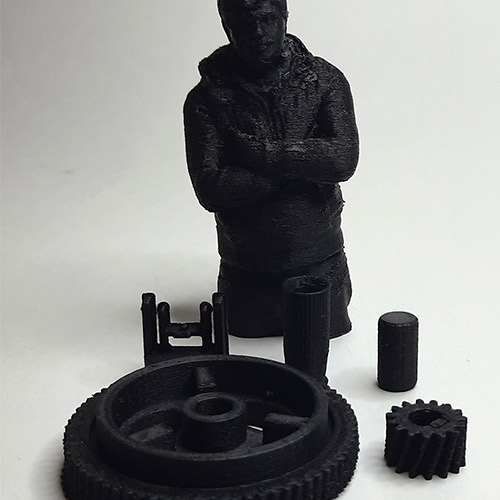
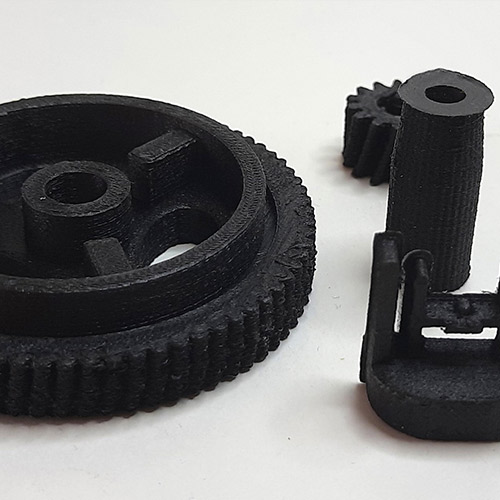
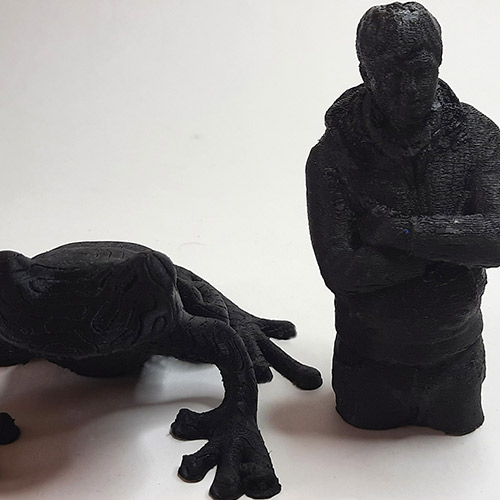
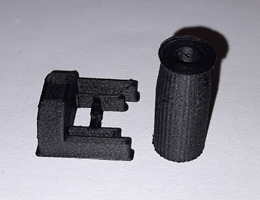
Carbon fiber sounds modern and high-tech, but that is not why it has become so popular in 3D printing. Its main advantage is the combination of excellent mechanical properties and improved stability during printing.
To understand why carbon fiber materials are so useful, we first need to talk about nylon.
Why not simply print with nylon?
Nylon, also known as polyamide (PA), is a very strong, durable and relatively flexible material. Compared with many common plastics used for 3D printing, its mechanical properties are excellent.
It might seem like the perfect material for producing strong functional parts. However, there is one significant problem: 3D printing with nylon can be difficult.
As nylon cools, it tends to shrink and warp. With larger parts or models with substantial infill, the edges can lift from the print bed. The entire part can deform, and the final dimensions may differ from the original 3D model.
This becomes especially important when you need a functional part with precise dimensions and predictable geometry.
What does carbon fiber add to nylon?
One solution is to add carbon fibers to polyamide. This creates materials such as PA-CF (carbon fiber reinforced polyamide).
The carbon fibers help stabilize the material during printing. Parts tend to warp less as they cool, maintain their geometry better and make it easier to produce relatively large components with good dimensional accuracy.
At the same time, the material retains many of the excellent mechanical properties of nylon.
There is, however, a trade-off. Adding carbon fiber makes the material stiffer, but in some applications it can also make the finished part more brittle. For this reason, PA-CF is not always the best choice for components that need to bend significantly or absorb repeated impacts.
A distinctive surface finish
Carbon fiber 3D printing also has an interesting visual advantage.
Printed parts usually have a slightly rough, matte surface. This helps hide the layer lines typically associated with FDM 3D printing and gives the finished part a clean and professional appearance.
For this reason, carbon fiber reinforced materials can be a good choice not only for functional parts but also for visible components, technical enclosures and decorative products.
Carbon fiber is abrasive
There is another important characteristic, although it mainly affects the person operating the 3D printer.
Carbon fibers are abrasive. During printing, the filament can act almost like very fine sandpaper on some components of the printer.
The nozzle is particularly affected. A standard brass nozzle can wear relatively quickly when regularly printing carbon fiber reinforced filaments.
For this reason, wear-resistant nozzles are normally used for 3D printing with carbon fiber materials.
When should you choose carbon fiber for 3D printing?
If you need a strong, rigid and dimensionally stable functional part, carbon fiber reinforced materials can be an excellent choice.
They are particularly suitable for:
- Technical enclosures
- Brackets and mounting components
- Mechanical parts
- Components for machinery and equipment
- Functional prototypes
- Parts subjected to mechanical loads
- Components requiring good dimensional stability
However, carbon fiber is not simply the “best” material for every 3D printing project. Like any material, it has its own advantages and limitations.
Before choosing a material for professional 3D printing, it is important to consider how the finished part will be used, what loads it needs to withstand, whether flexibility is required and how important dimensional accuracy is.